
What will this subject enable me to do?
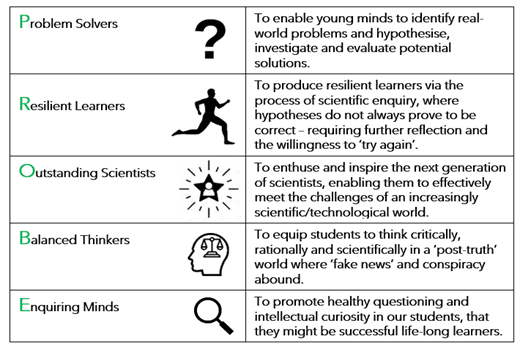
Our Science provision aims to enable all pupils to access an outstanding curriculum, which will produce in them ‘PROBE’ characteristics.
Department Staff
J Lightfoot
A Hussain
J Bell
S Dewhurst
K Garvey
S Goodall
A Holland
L Howard
P Holmes
T Johnson
O Jones
P Scott
M West
A Whetton
Keystage 3
Homework will be set via Satchel One and will comprise of activities designed to consolidate student knowledge, supported by homework booklets which will be given to each student at the start of the year. At the end of each topic, students will complete a formal test, designed to assess pupil progress and attainment.
Year 7
| Unit | Skills | Assessment |
| Introduction to Science | Students will learn how to work safely in a Science laboratory. They will also develop their ability to plan investigations, record collected data appropriately, analyse results and evaluate the practical. | Baseline Test |
| Biology | In Y7 Biology, students will study the structure of cells and observe them using microscopes. Students will then use their new understanding of specialised cells to consider reproduction in humans and plants, as well as how the human body changes throughout adolescence. Finally, students will learn about the human digestive and respiratory systems and how the organs in these systems are adapted to perform their functions effectively. | Formal Test |
| Chemistry | In Y7 Chemistry, students will learn about particle theory and differences in particle arrangement and energy in the three states of matter: solids, liquids and gases. Students will also learn about atoms as the building blocks of all matter and how the terms ‘elements’ and ‘compounds’ relate. They will also have an opportunity to carry out a range of separation techniques in the ‘Mixtures’ unit, including filtration, crystallisation, distillation and chromatography. In the ‘Reactions’ unit, students will investigate the differences between physical and chemical changes and exo/endothermic reactions. | Formal Test |
| Physics | In Y7 Physics, students will learn about the forces that surround us and develop this ‘big idea’ further in the ‘Gravity and Space’ topic, where our home in the Universe – our Solar System – is closely studied. Magnetism is explored in some detail as an example of a non-contact force and students will have opportunities to investigate electricity and build different types of circuit. | Formal Test |
Year 8
| Unit | Skills | Assessment |
| Biology | In Y8 Biology, students will learn about how humans move via their skeletal and muscular systems and how the energy for movement itself is provided by cellular respiration. Students will also learn about the environment – how all life depends on the ability of plants to create their own food using energy from the Sun via photosynthesis – and how organisms are interconnected in food chains and food webs. Human health will also be considered in relation to drugs – legal, illegal, medicinal and recreational. Students will also consider the microscopic organisms (microbes) and grow bacterial cultures on agar plates. | Formal Test |
| Chemistry | In Y8 Chemistry, students will have lots of practical opportunities to consider acids and how they react with alkalis, metals and metal carbonates. The Earth’s structure and atmosphere will also be evaluated, in addition to how our atmosphere is changing today. Students will learn about the problems associated with these changes – such as global warming acid rain – and the implications of these on human society at the international, national and individual level. | Formal Test |
| Physics | In Y8 Physics, students explore the concept of waves and how oscillations cause the phenomena that we call ‘light’ and ‘sound’. In ‘Pressure and Moments’, students learn what the scientific definition of ‘pressure’ is and how pressure is exerted in different media (solids, liquids and gases). Students will also develop their mathematical skills in manipulating the ‘moment’ formula to work out either moment (Nm), force (N) or distance (m). | Formal Test |
Keystage 4
Students will study either Edexcel Combined Science or the Edexcel Single Sciences (Biology, Chemistry and Physics).
Homework and Support
In Y11, the primary Science homework is Tassomai completion – 4/7 Daily Goals a week. Tassomai is a personalised revision platform (accessed via the app or website) that supports students with their retrieval and application of curriculum content. Students will be given a formal assessment at the end of each topic.
Revision sessions are held most days from January onwards and during the Easter holidays.
| Component | Content | Assessment |
| Biology | Topic 1 – Key Concepts in Biology Topic 2 – Cells and Control Topic 3 – Genetics Topic 4– Natural Selection and Genetic Modification Topic 5 – Health, Disease and the Development of Medicines Topic 6 – Plant Structures and their Functions Topic 7 – Animal Coordination, Control and Homeostasis Topic 8 – Exchange and Transport in Animals Topic 9 – Ecosystems and Material Cycles | 33 % (Combined) 100% (Single) 2 exams, each: 70 mins (Combined) 105 mins (Single) |
| Chemistry | Topic 1 – Key Concepts in Chemistry Topic 2 – States of Matter and Mixtures Topic 3 – Chemical Changes Topic 4 – Extracting Metals and Equilibria Topic 6 – Groups in the Periodic Table Topic 7 –Rates of Reaction and Energy Changes Topic 8 – Fuels and Earth Science | 33 % (Combined) 100% (Single) 2 exams, each: 70 mins (Combined) 105 mins (Single) |
| Physics | Topic 1 – Key Concepts of Physics Topic 2 – Motion and Forces Topic 3 – Conservation of Energy Topic 4 – Waves Topic 5 – Light and the Electromagnetic Spectrum Topic 6 –Radioactivity Topic 8 – Energy - Forces Doing Work Topic 9 – Forces and their Effects, Topic 10 – Electricity and Circuits Topic 12 – Magnetism and the Motor Effect Topic 13 – Electromagnetic Induction Topic 14 – Particle Model Topic 15 – Forces and Matter | 33 % (Combined) 100% (Single) 2 exams, each: 70 mins (Combined) 105 mins (Single) |
Keystage 5
A level Biology (OCR) (Syllabus A)
Content
- Module 1 – Development of Practical Skills in Biology
- Module 2 – Foundations in Biology
- Module 3 – Exchange and Transport
- Module 4 – Biodiversity, Evolution and Disease
- Module 5 – Communication, Homeostasis and Energy
- Module 6 – Genetics, Evolution and Ecosystems
| Assessment | |
| Biological Processes (01) 100 marks 2 hour 15 minutes written paper | 37% of total A level |
| Biological Diversity (02) 100 marks 2 hour 15 minutes written paper | 37% of total A level |
| Unified Biology (03) 70 marks 1 hour 30 minutes written paper | 26% of total A level |
| Practical Endorsement in Chemistry (04) non exam assessment |
OCR A level Chemistry (Syllabus A)
Content
- Module 1 – Development of Practical skills in Chemistry
- Module 2 – Foundations in Chemistry
- Module 3 – Periodic Table and Energy
- Module 4 – Core Organic Chemistry and Analysis
- Module 5 – Physical Chemistry and Transition Elements
- Module 6 – Organic Chemistry and Analysis
| Assessment | |
| Periodic Table, Elements and Physical Chemistry (01) 100 marks 2 hour 15 minutes written paper | 37% of total A level |
| Synthesis and Analytical Techniques (02) 100 marks 2 hour 15 minutes written paper | 37% of total A level |
| Unified Chemistry (03) 70 marks 1 hour 30 minutes written paper | 26% of total A level |
| Practical Endorsement in Chemistry (04) non exam assessment |
OCR A level Physics (Syllabus A)
Content
- Module 1 – Development of Practical Skills in Physics
- Module 2 – Foundations in Physics
- Module 3 – Forces and Motion
- Module 4 – Electrons, Waves and Photons
- Module 5 – Newtonian World and Astrophysics
- Module 6 – Particles and Medical Physics
| Assessment | |
| Modelling Physics (01) 100 marks 2 hour 15 minutes written paper | 37% of total A level |
| Exploring Physics (02) 100 marks 2 hour 15 minutes written paper | 37% of total A level |
| Unified Physics (03) 70 marks 1 hour 30 minutes written paper | 26% of total A level |
| Practical Endorsement in Physics (04) non exam assessment |
BTEC Level 3 National Diploma in Applied Science
Equivalent in size to two A Levels. Comprised of 8 units of which 5 are internally assessed and 3 are externally assessed.
Units
- Principles and Applications of Science I – Exam
- Science Investigation Skills – Exam
- Principles and Applications of Science II – Exam
- Investigative Project – Portfolio of work
- Practical Scientific Procedures and Techniques – Portfolio of work
- Laboratory Techniques and their Application – Portfolio of work
- Diseases and Infections – Portfolio of work
- Physiology of Human Body Systems – Portfolio of work
BTEC Level 3 National Certificate in Applied Science
Equivalent in size to one A Level. Comprised of 4 mandatory units of which 2 are internally assessed and 3 are externally assessed.
Units
- Principles and Applications of Science I – Exam
- Science Investigation Skills – Exam
- Practical Scientific Procedures and Techniques – Portfolio of work
- Physiology of Human Body Systems – Portfolio of work